



The fine folks from McKinsey have open-sourced an AI-enabled dashboarding workflow. In my opinion, it's useful for businesses and strategically valuable to generate insights. It's called Vizro.
Rapid dashboarding alternatives like Claude in Excel require
- more work and prompting (attention to detail)
- you need to email or SharePoint-share the files around
- people on macOS often can't open the files, and the other way around
Vizro is simple enough. I ran it for research and development on a self-hosted PyCafe. PyCafe allows hosting genAI'ed dashboards with ease. The Python tools are contained in WebAssembly (Pyodide). That's very modern and too modern for Microsoft Edge in my tests. Chrome worked fine.
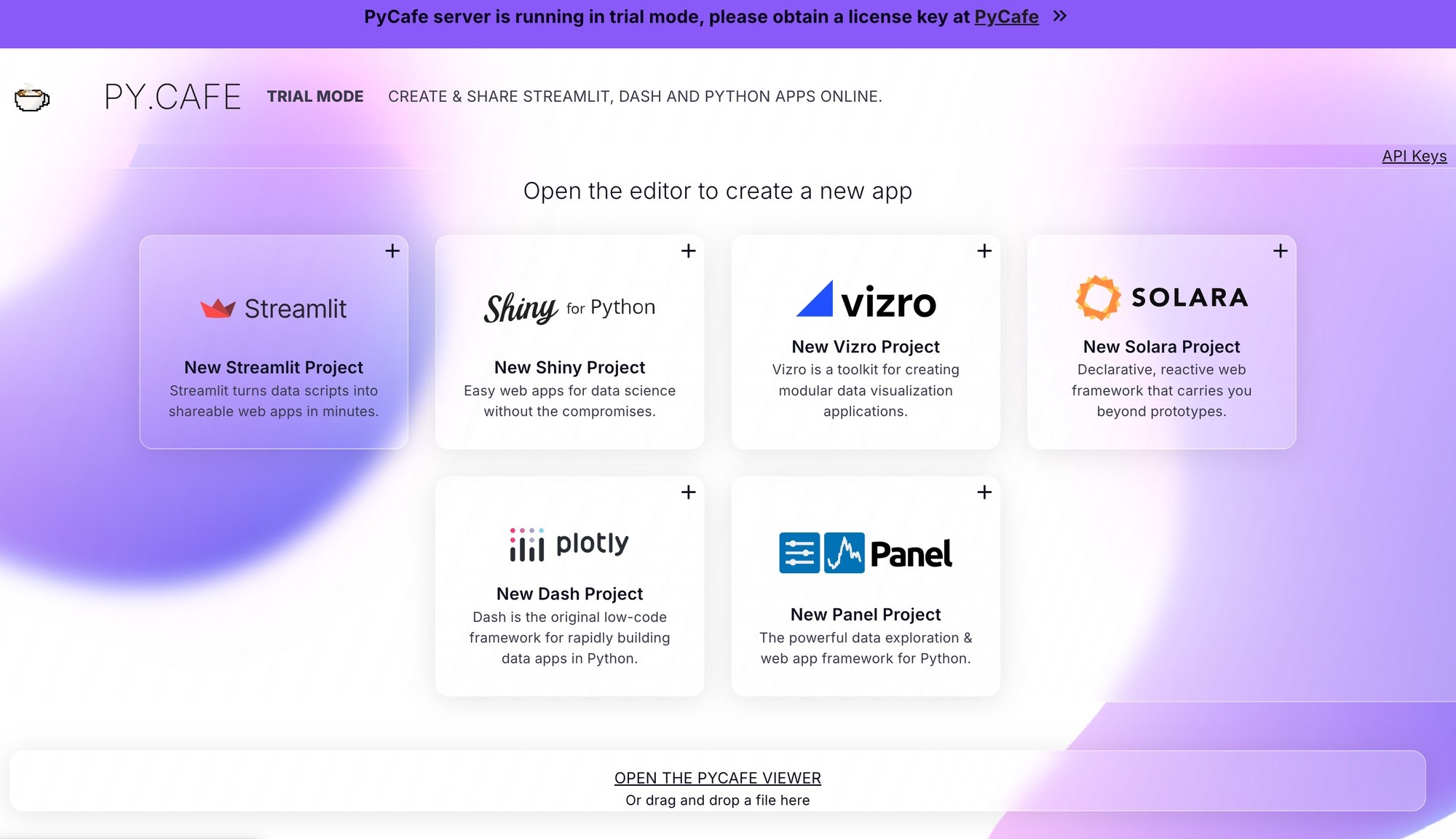
Why self-host?
If you process
- Institutional data (proprietary, classified, or expensive datasets)
- Think of how much marketing needs to spend to acquire customers
- Private data
- Unique data with an edge that gives you market advantages
... then you are well advised to keep it safe and sound.
How?


Here is what irritates me. McKinsey has Vizo out, and the AI integration systems (MCP servers) do not support custom URLs for self-hosted dashboards. I assume they use their own framework, right?
I added support to Vizro MCP (it's easy and licensed as open-source) and added my patched integration to Hermes.
AI workflow with Vizro and Hermes Web
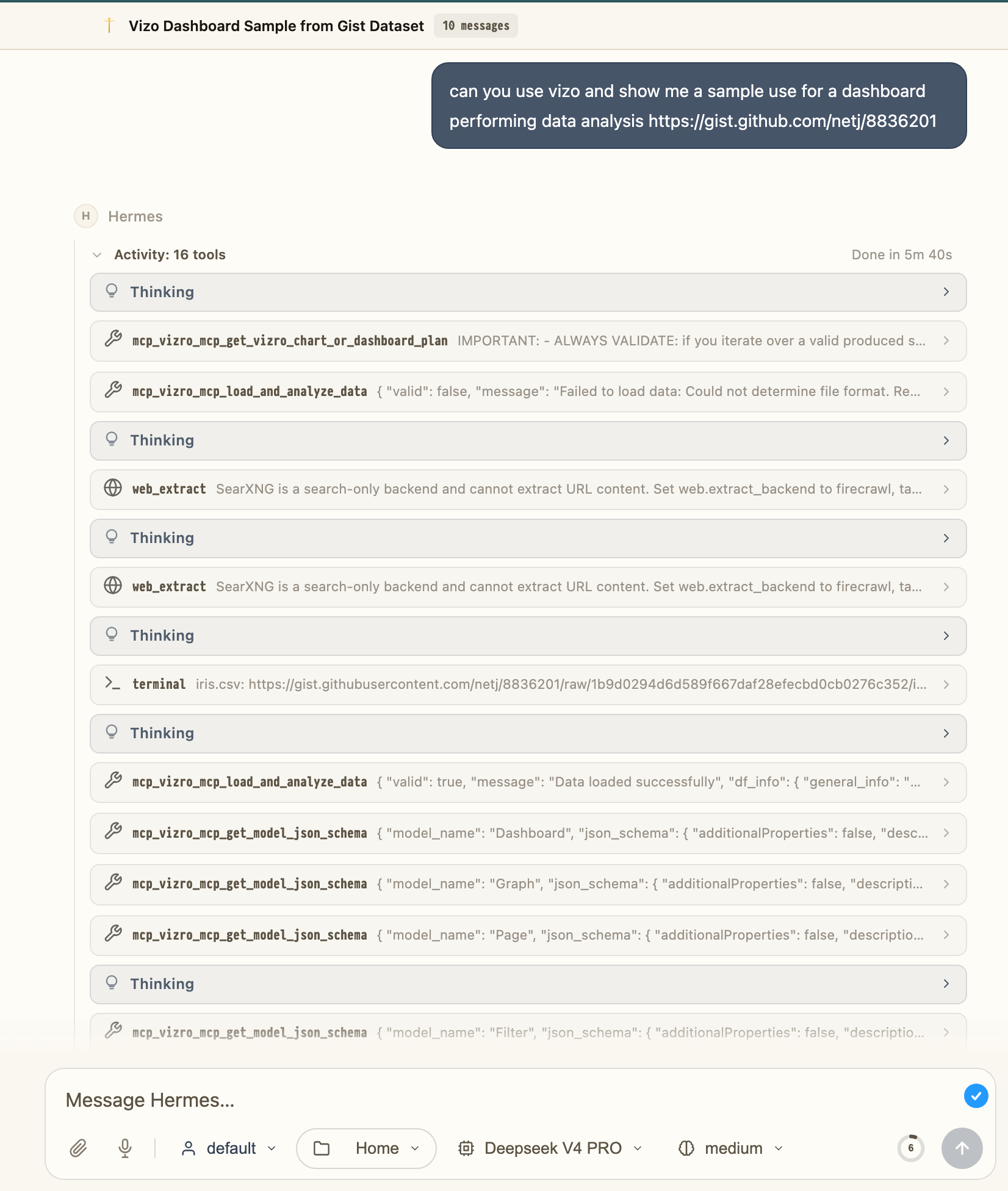
What happened?
- two lines of natural language
- Python code generation with an open-weights model
- URL gets generated via (the patched) Vizo MCP that posts the code to PyCafe
- PyCafe loads Vizo into Chrome
- Chrome opens the dashboard
Two minutes. No installation. No tech barriers. Granted, the result could need improvements. But that's ok. Commit your critique to memory; let Hermes figure it out next time. It learns.
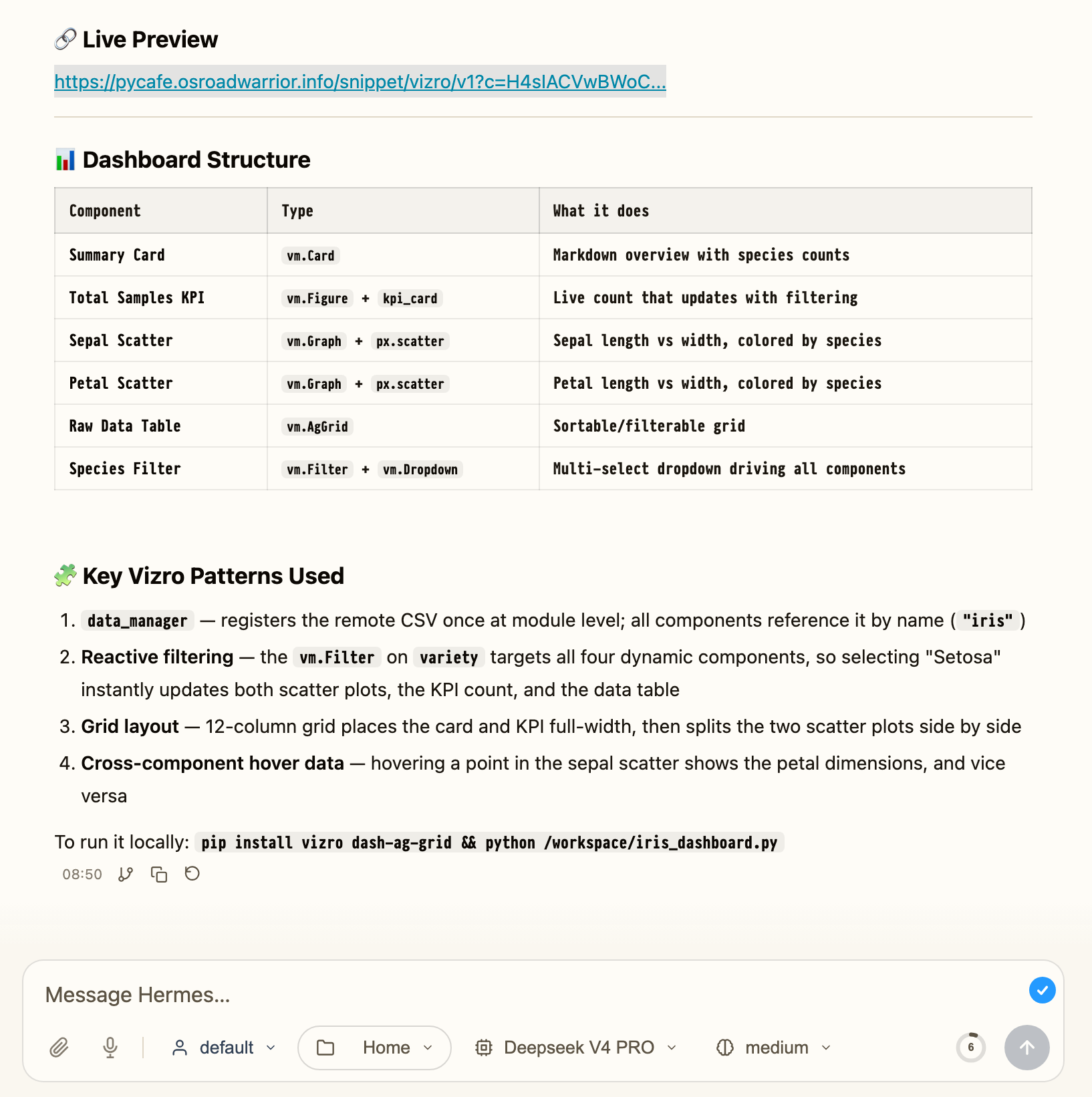
Summary
- no Shadow IT (all centralized in PyCafe, no VMs or containers for dashboards)
- self-hosted, full control
- end-to-end ownership of the whole process, including the model (DeepSeek v4 Pro)
- privacy-focused / fit for use-cases with a proprietary edge
- high-end 2026 (WebAssembly, self-learning agent, open-weight LLM)
- self-improving (knowledge corpus with memory)
- a learning curve for the agents
Yes, the data science isn't spectacular.
You can specify this in a prompt, maybe by using Gartner's ReFlect framework.
You can preload your goals into context and scale autonomy with measurable goals. For example, by using specifications written in EARS.