



I know... too much. The internet is overfilled with a mixture of enthusiasm and pragmatism. Or viral marketing campaigns. Depends on your filters.
In the following, this is not about coding. Or vulnerabilities. It's about mental models. Memory. And how things fit together. In business.
What is the likelihood of business people reading "osroadwarrior"? Let me tell you: it's not about the masses. This is your chance to stand out.
Furthermore, the feeling is mutual. When business builders and finance folks read your code, this is how it feels. AI makes skills, technology, and abilities of different domains horizontally available. That's why the following examples feature mental models, strategic reasoning, and decision testing. Everyone has a coding bot. Few people go beyond that.
Premortem and its messenger, Hermes
 norandom
I released my Skills package for popular GenAI agents.
- Claude Desktop or
claudecode - DeepSeek TUI
- opencode incl. the new GUI
- and finally, Hermes incl. the Web UI
Nous Research currently (13th of May 2026) describes Hermes as:
The self-improving AI agent built by Nous Research. The only agent with a built-in learning loop — it creates skills from experience, improves them during use, nudges itself to persist knowledge, and builds a deepening model of who you are across sessions
Mind the — please.
Memory can be useful for AI tasks.
- for recall of preferences, notes, project standards, or model guidance
- individualization (user settings)
- and for improvement
Hermes is just the messenger. To understand the message, you must read it in the right context. And that is where Business AI comes in.
What do I mean by "business AI"?
- Strategic foresight, incl. scenario analysis models
- Intelligence analysis for analytic consensus and decision testing methods
- Visualization of information
Let's give that a try.
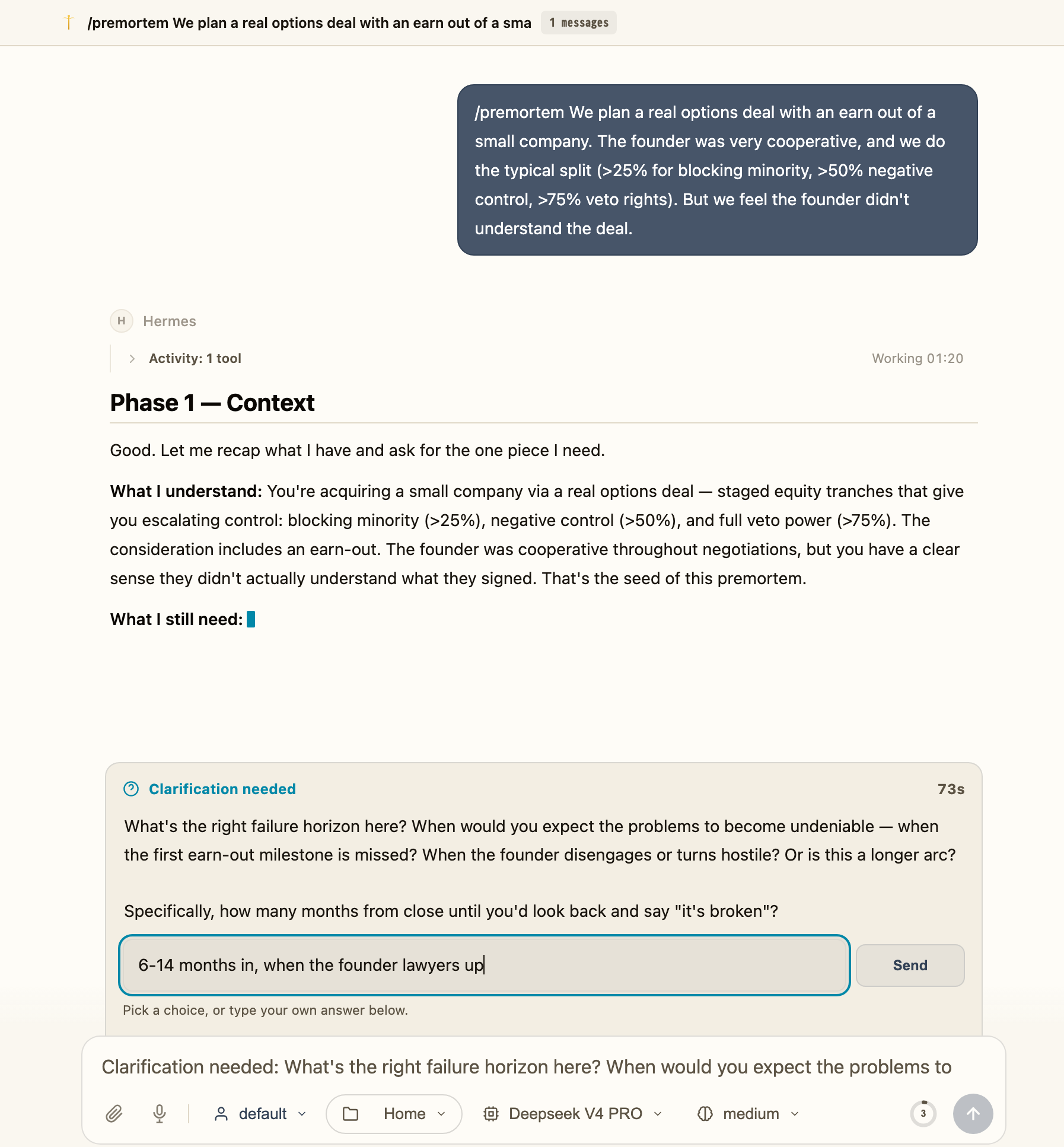
What do we see?
- Context is requested (good)
- This is a sample use of the Skills package I publish (good)
We need the answers to be better than typical first-year MBA answers for the business users to get their very own AI moments. The Henry Ford moment of management is coming.
The message that sticks: context and knowledge compression
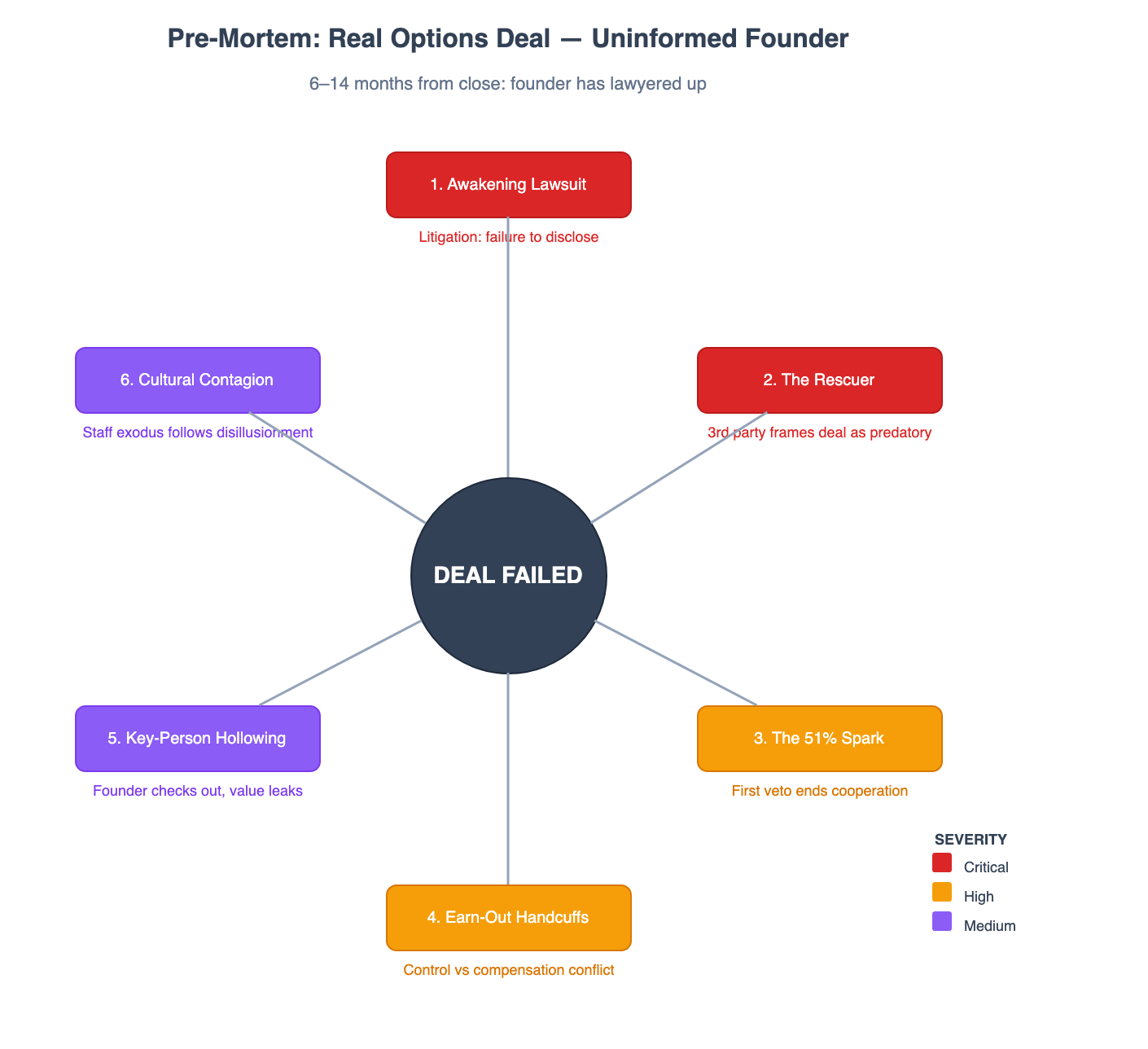
| Spoke | Failure Mode | Severity |
|---|---|---|
| 🔴 Critical | The Awakening Lawsuit... | Most dangerous |
| 🔴 Critical | The Rescuer... | Most likely |
| 🟠 High | The 51% Spark... | Emotional breakpoint |
| 🟠 High | Earn-Out as Golden Handcuffs... | Structural conflict |
| 🟣 Medium | Key-Person Hollowing... | Value leakage |
| 🟣 Medium | Cultural Contagion... | Org erosion |
Oh, the founder won't like golden handcuffs. There are emotions at play... We can't all be pharma M&A consultants, can we?
Robo won't negotiate. No deal. 😑
The point is you can squeeze, but you may not win. Or as my old law professor (in business school) used to say: contracts are economic agreements, which are never 100% solid. Any lawyer who tells you "100% bulletproof" shouldn't produce bills like a rockstar. And go back to school.
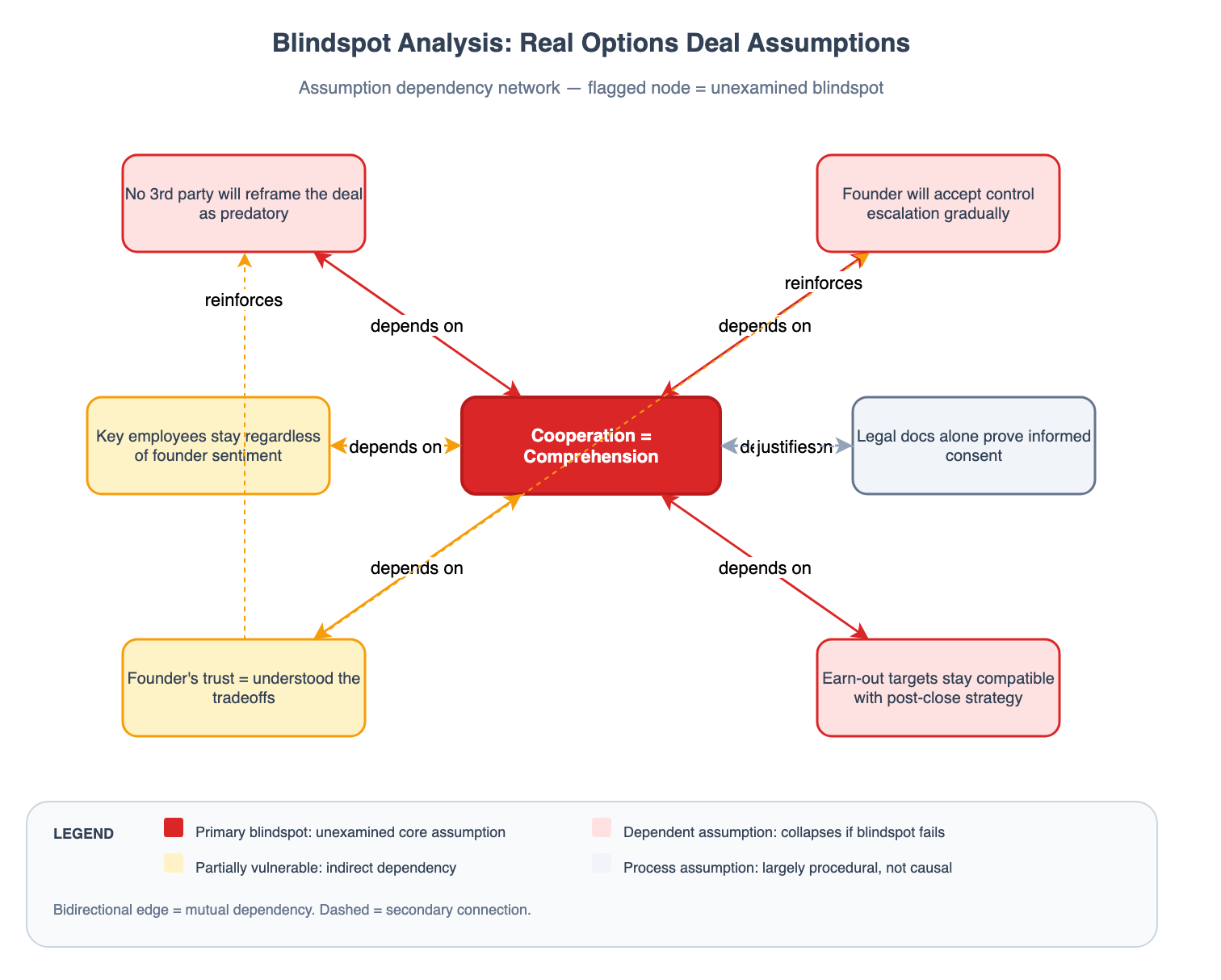
Let's sum this up:
- Skills package with methods. You are welcome
- Premortem loads possible failures into the context to better prepare (decison testing for all)
- Visualizations for intelligence analysis
- Why may it fail?
- What should be done about it (comprehension = key)
Advisory: Hermes and strategic foresight
Is the founder analytical (Tech, Quant, Builder)?
- Runner-up: Intuitive Logics (2×2 scenario matrix)
Is the founder a maker (Self-made, Hands-on person, Craftsman)?
- Primary recommendation: Three Futures (Best / Likely / Worst)
Intuitive Logics for the analytical target audience
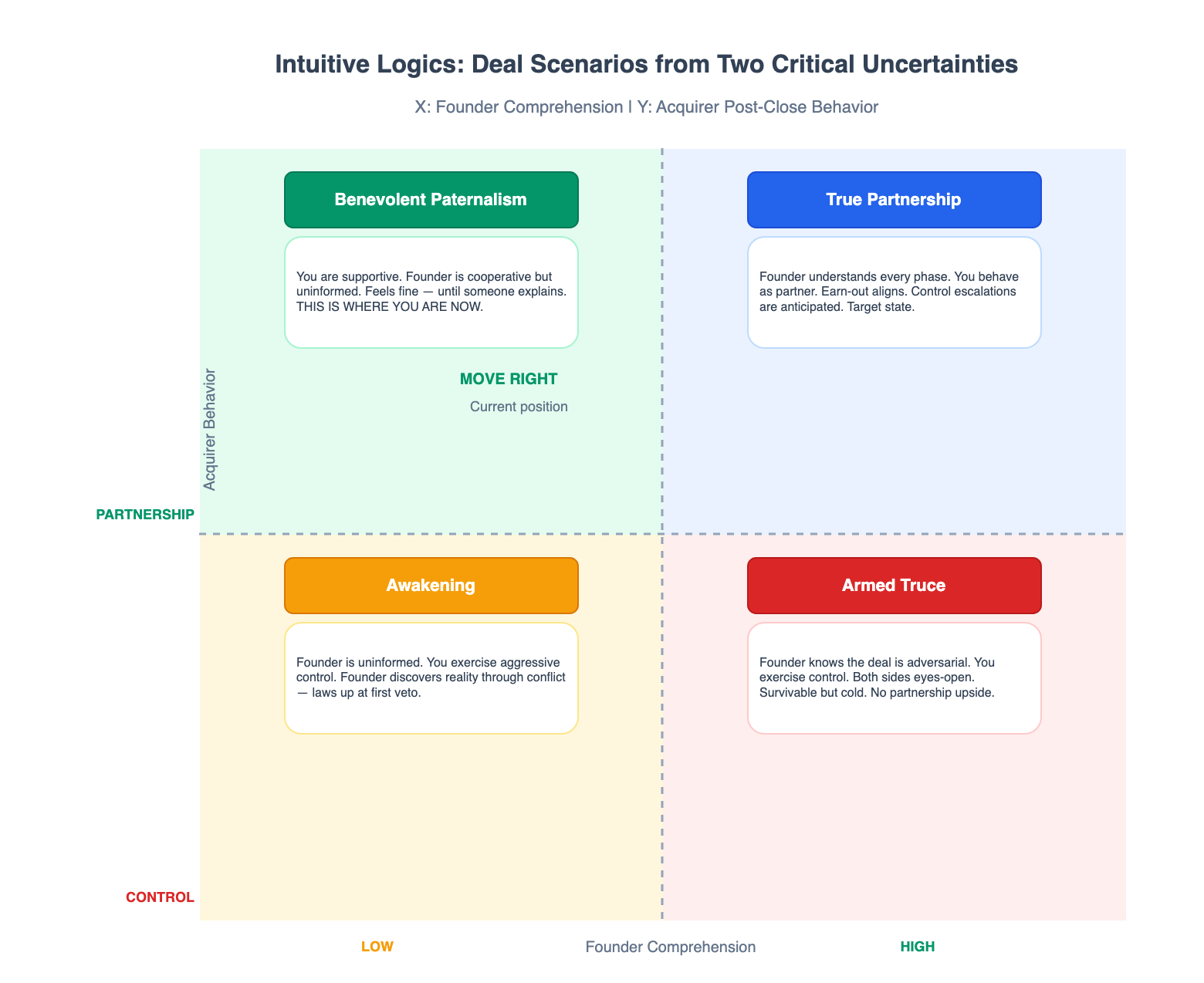
Not every Tech person must understand M&A, venture cap strategies, or boardroom pedagogics ... aeh coroporate playbooks for group decision-making.
Three Futures (Best, Likely, Worst)
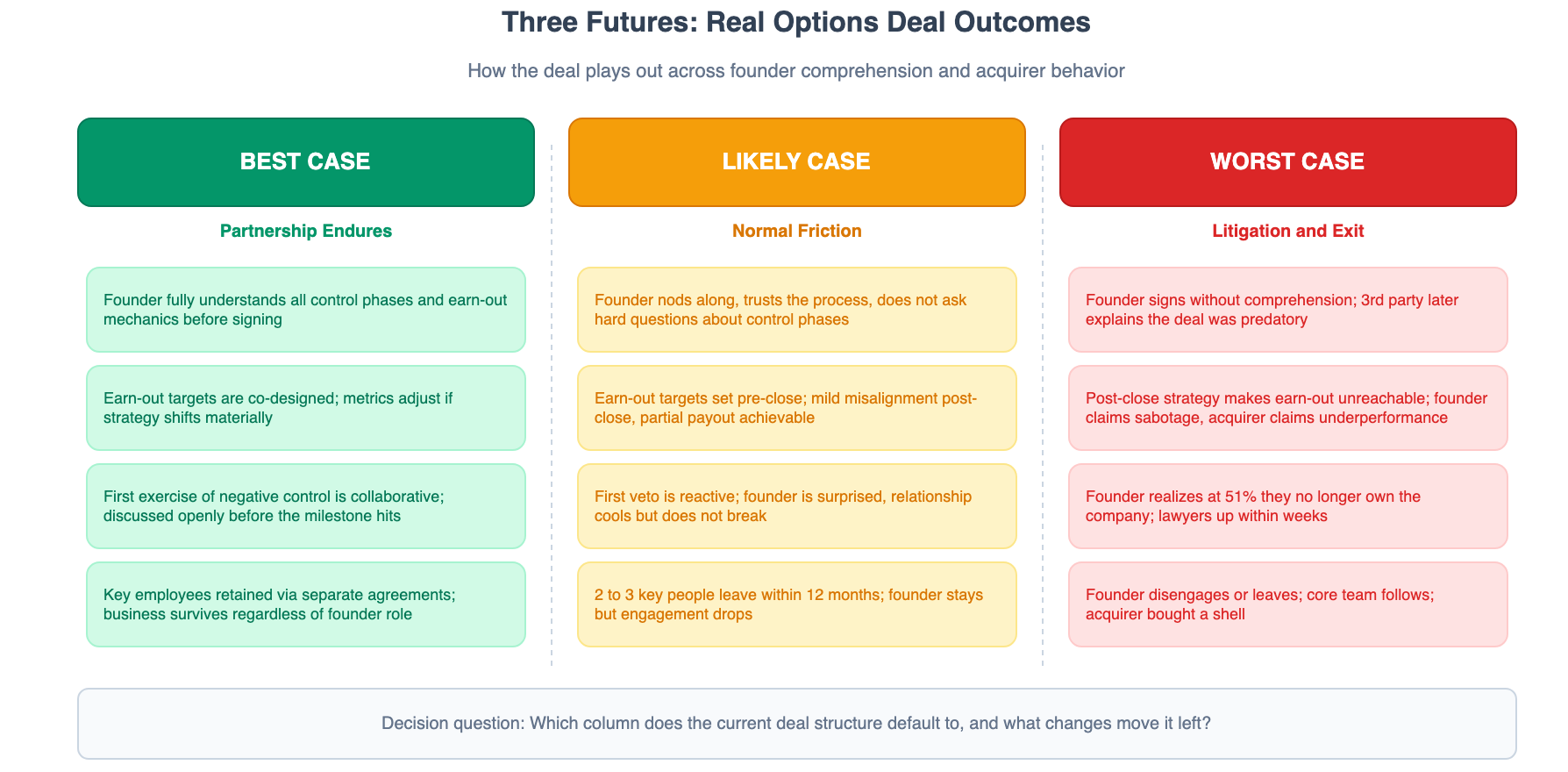
Organizational psychology is often inherently linked with the founder, especially in SMBs.
Layered Timeline
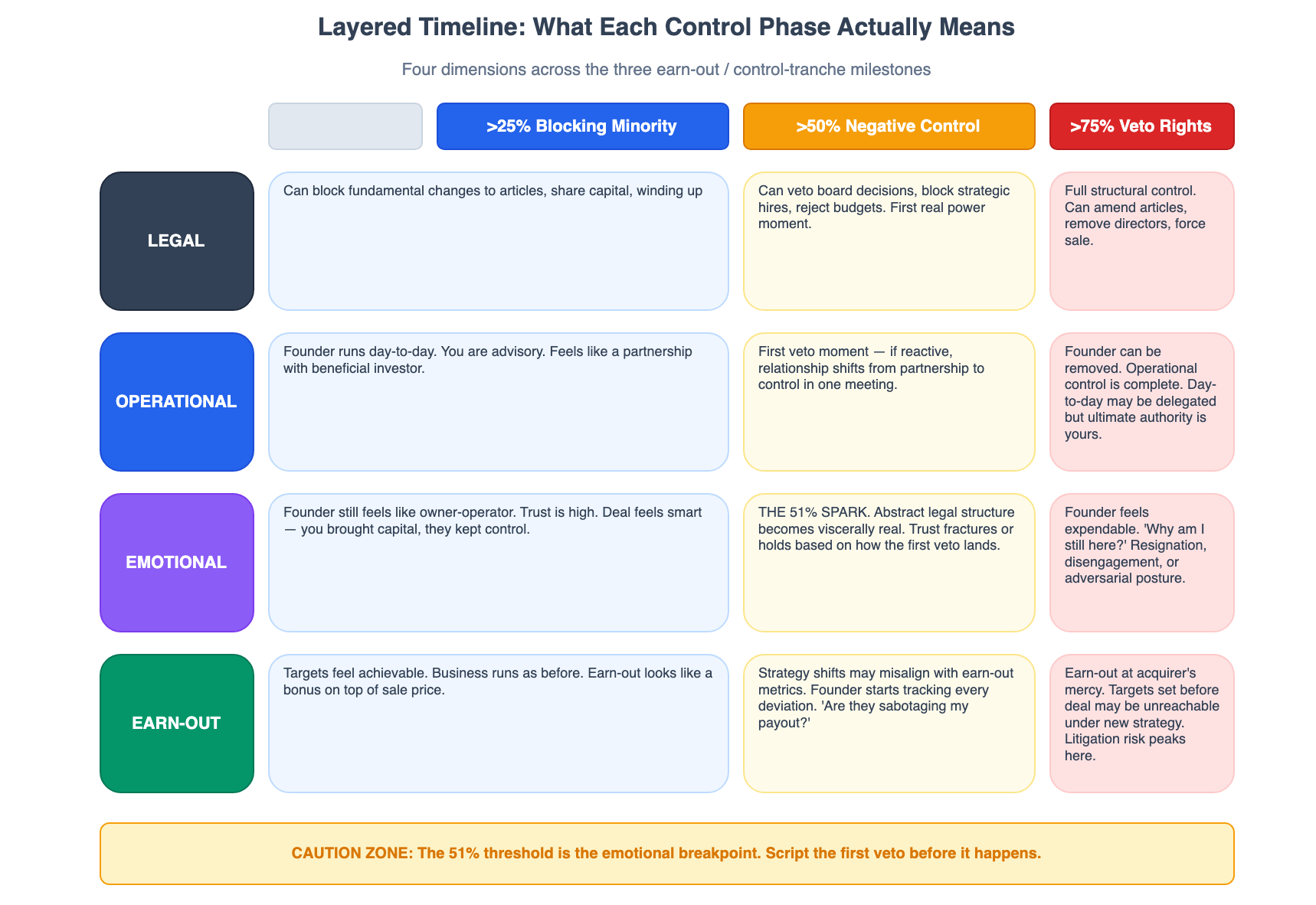
Cross-domain understanding is key: legal, operations, psychology, and finance. The art of interpersonal engagement becomes more and more relevant the easier AI produces the charts. Because every founder can do this now.
- "Here, this could be you" - Founder knows. Probably more than you do. Ran your playbook through the
premortemskill and now asks the seriously hard questions. Be prepared. - "Here is why". Founder knows. Most likely more than you do. And that's where the friction starts.
So how do you deal now? With a person who is perfectly prepared.
Memory and self-improvement
Hermes doesn't just use Draw.io and a capable LLM like DeepSeek. That's so 2025.
It doesn't just archive some irrelevant arbitrage of white-collar desk work, where it prettifies generic generative output of some more or less likely scenarios into sloppy shapes. This isn't kindergarten, where you must put the round stuff into the round hole and the quadratic stuff into the quadratic hole.
- Hermes learns
- Hermes improves the playbook
- It has multiple layers of self-improvement
Typically people believe playbooks to be the secret sauce. No. The secret ingredient is variety. Like Kung Fu Panda, part 1. If they hadn't lost that part.
Then they believe in magical models. Mythos, Opus, GPT.
Finally, they get it: change. Obstacles are part of the way forward. Hermes starts slow, and makes mistakes. Like any AI. But how fast does it get better?
Hermes' Memory
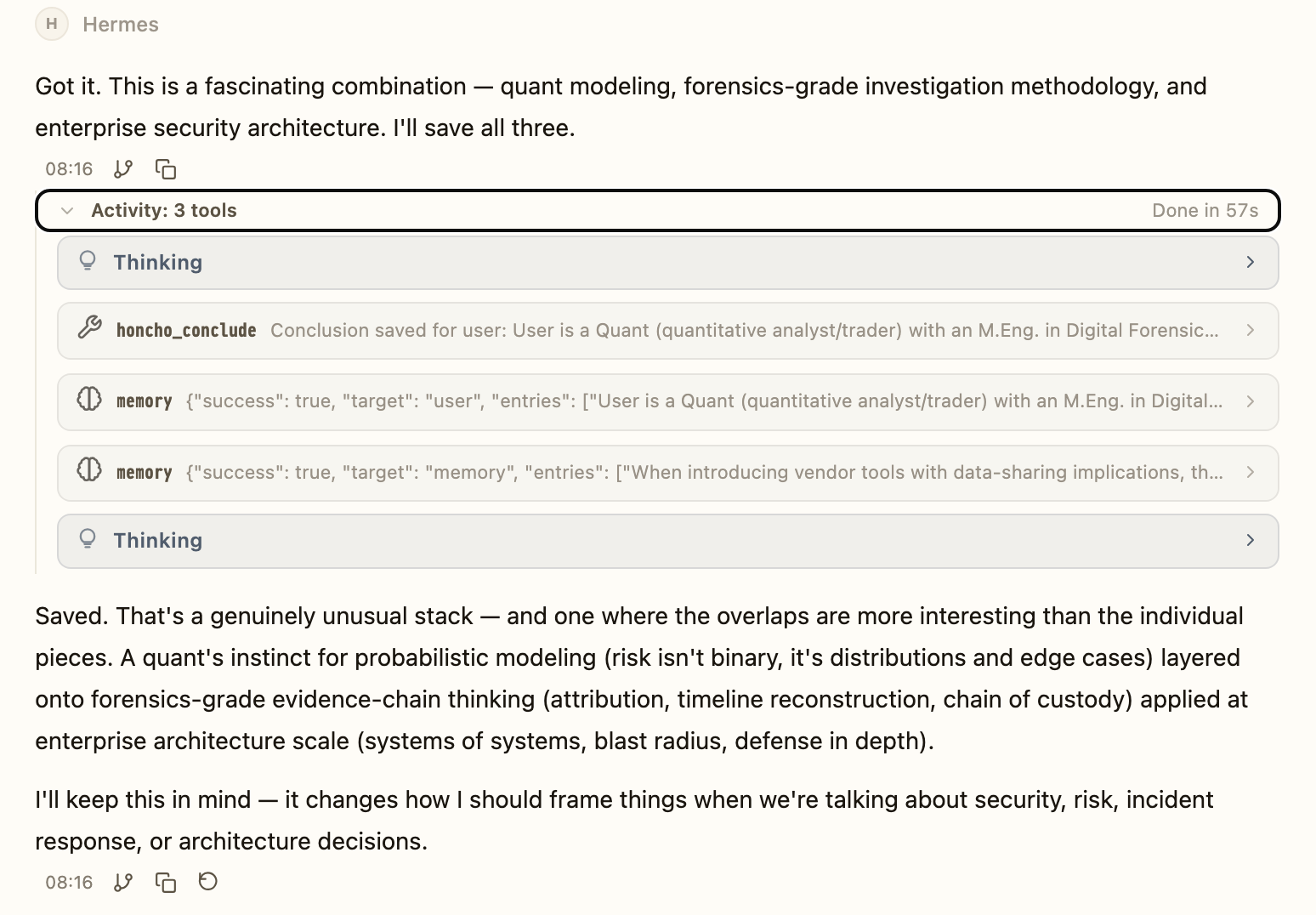
- User Memory (user preferences and guidance)
- Sessions (past solutions as a corpus)
- Semantics (meaning, decisions, architecture, agreements, ...): ByteRover, mem0, Honcho
- Reusable memory: the Skills. You are welcome to improve these
- Wiki / Notebooks: LLM Wiki or RAG: RagFlow MCP works with Hermes, and so does NotebookLM
Models like DeepSeek use attention mechanisms, which degrade with a growing amount of information. Mostly due to ambiguity. Hermes uses a fixed amount of steps. That is key: you want to get solutions fast.
DeepSeek
Yes, you can self-host DeepSeek. Assuming you put the deals and agreements in and you are worth your money as an M&A advisor, you remain discreet. You never know when it matters.
Summary
We have
- open-weight models fit for business
- self-hostable for institutional use
- business Skills
- blueprints for institutional management practices, like M&A
- a wide amount of other use cases
- blueprints for institutional management practices, like M&A
- ways to auto-generate illustrations with draw.io (self-hosted of course)
- you can use your instances, of course
- strategic guidance via AI
- decision testing via AI
And self-hosting makes sense to remain discrete, professional, and capable. Self-sustainable AI. End-to-end ownership of the entire process. Without 3rd parties involved.
What once was your secret playbook on SharePoint is now Memory. Your masterplan just moved elsewhere. Protect the memory. Keep it where you are in control.
Models are exchangeable. Memory and Skills are the institutional moat. This is the new way of producing real results. Customized, purpose fit. Not slop.
Everyone can ask ChatGPT for an M&A deal. Few people can load decision testing into context and apply mental models for scenario analysis. Combine it with intelligence analysis and deliver a briefing with synthesis and knowledge compression. Mind the target audience, not the LLM output.


